
For wholesale fabric hair accessories, ask what part of the product each supplier material term describes. Haiyan lists Fabric + Rubber + Alloy for Pink Fabric Scrunchie 27, Fabric + Rubber for Gray Fabric Scrunchie 28, and Fabric + Synthetic Resin for Black Fabric Headband 32. Keep those statements on separate product rows. They do not, by themselves, identify every component or establish that an unlisted material is absent.
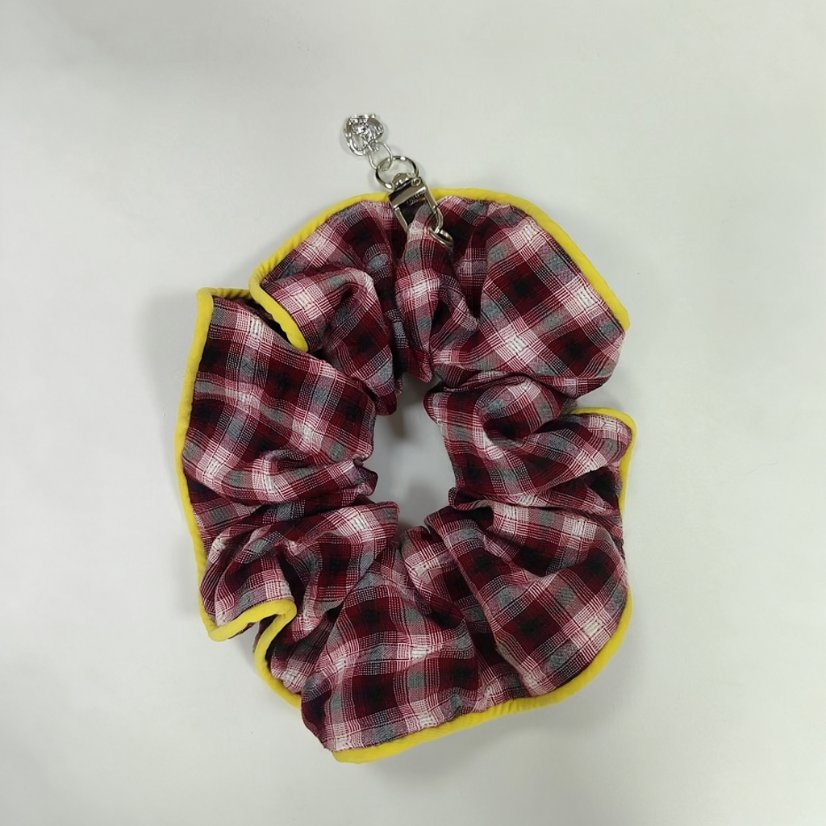
Official Pink Fabric Scrunchie 27 appearance reference. The visible attachment does not independently establish which part the supplier’s alloy wording describes.
Keep the material line attached to Scrunchie 27
The Pink Fabric Scrunchie 27 page belongs to the Campus Chaos Collection and lists Fabric + Rubber + Alloy as its main material description. Its photograph shows a checked, gathered accessory with a contrasting-looking edge and a decorative attachment. Use the full product reference when asking the supplier to explain how the material wording maps to the current offered version.
Do not assign alloy to a particular visible piece solely because that piece looks metallic. A surface appearance does not identify composition. Ask the supplier to point to the relevant component and state what its description covers. The buyer can preserve the listed wording while keeping the component mapping open until the supplier supplies a model-specific answer.
Do not copy the alloy statement into Scrunchie 28
Official Gray Fabric Scrunchie 28 reference, a separate product. Decorative appearances and labels do not verify composition or establish the absence of an unlisted material.
The Gray Fabric Scrunchie 28 page lists Fabric + Rubber. Keep that as its own supplier statement rather than adding alloy because another scrunchie in the collection includes that term. A shared collection name does not establish a shared component list.
The reverse inference is also unsupported: the omission of alloy does not prove that every part of Scrunchie 28 is metal-free. If the buyer needs a complete material breakdown, request it for the offered product. Record whether the supplier’s reply covers the gathered fabric, the internal elastic element, decorative details and any attached label, rather than assuming the short main-material line is an exhaustive declaration.
Product reference | Supplier main-material wording | Component-scope question
Pink Fabric Scrunchie 27 | Fabric + Rubber + Alloy | Which components does each term describe?
Gray Fabric Scrunchie 28 | Fabric + Rubber | What is covered, and what additional detail is available?
Black Fabric Headband 32 | Fabric + Synthetic Resin | Which offered component is described as synthetic resin?
The table preserves catalogue descriptions. It is not a laboratory result, a complete composition declaration or a product-performance comparison.
Keep the headband construction question separate
Official Black Fabric Headband 32 appearance reference. The photograph does not establish the composition of its body, decoration or attached details.
The Black Fabric Headband 32 page lists Fabric + Synthetic Resin. This is a different product form from the two gathered scrunchies. Ask the supplier which part of the offered headband the resin wording identifies, rather than importing the rubber description from a scrunchie or assigning resin to a particular visible decoration.
The visible dots and button-like details can be marked on an enquiry image to make the question precise. They should not be identified as a particular material from their colour or shine. Likewise, the main-material wording does not establish flexibility, pressure, comfort or another use property. Keep a material-description request distinct from any separate performance question the buyer may have.
Ask for a component map without inventing percentages
A short component map can identify the visible or described parts and record the supplier’s material response beside each one. Ask whether the reply covers the whole offered item or only its main body. Where the supplier uses the broad word fabric, request whatever further description is relevant to the project rather than turning that word into cotton, polyester or an assumed fibre percentage.
Similarly, rubber and synthetic resin are catalogue terms here, not full formulation disclosures. The enquiry does not need an invented composition to look complete. Keep missing detail as a question and retain the supplier’s exact response. If the buyer needs supporting information, connect it to the same product and offered version rather than using a document for another accessory as a substitute.
• Identify the full collection title, product type and number on each row.
• Preserve each product’s own main-material description.
• Ask which body, elastic or decorative components the description covers.
• Keep unlisted materials and unspecified percentages as open questions.
Link the answer to the submitted sample
When a sample is offered, record its product identity and the material response that belongs to it. An appearance match can help identify the intended reference, but it does not independently verify the supplied composition. Keep the sample’s visual review and the supplier’s material information clearly connected without treating either as a substitute for the other.
If a decorative detail or another component changes, ask whether the material description changes with it. Preserve the earlier version so purchasing staff can see which answer applies to the current proposal. Send the separate rows through the Haiyan contact page. The useful result is a component-level supplier response for the intended accessory, with no assumption that a whole collection shares one complete material specification.
Frequently asked questions
Does Scrunchie 27’s alloy wording identify the visible attachment?
The page does not map the term to a particular component. Ask the supplier to identify the part it describes.
Does Scrunchie 28’s shorter material line prove it is metal-free?
No. An omitted term does not establish absence. Request a complete applicable breakdown if that information is needed.
Can the headband’s decorative material be identified by appearance?
No. Use the image to point to the component and request a product-specific supplier description.
Does the word fabric establish a fibre percentage?
No percentage is supplied by that word. Keep further material details as an enquiry for the current offered accessory.
Product and contact references
https://haiyanhair.com/product/campus-chaos-collection-pink-fabric-scrunchie-27/
https://haiyanhair.com/product/campus-chaos-collection-gray-fabric-scrunchie-28/
https://haiyanhair.com/product/campus-chaos-collection-black-fabric-headband-32/
https://haiyanhair.com/contact/